
Our Products
+
REGIONAL EXPERTISE
Premium GCC Oils & Fats Supplier
A trusted B2B partner across the Gulf – purity, scale and consistency in every batch.
Learn More →A trusted B2B partner across the Gulf – purity, scale and consistency in every batch.
Learn More →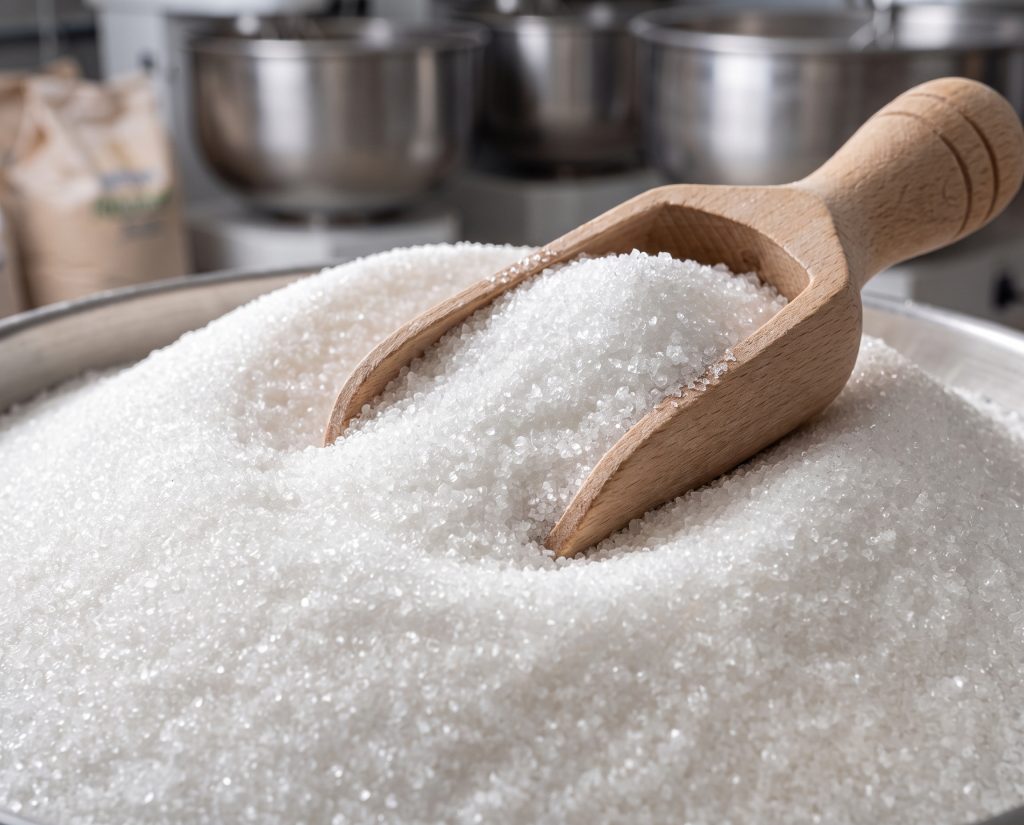
Sugar is often described as a sweetener, but in industrial bakery and confectionery production it performs a much broader technical role. It can influence texture, moisture distribution, colour development, aeration, crystallization, viscosity and mouthfeel. Even when two sugars have the same basic composition, differences in particle size and physical form can change the way they behave on the line.
For bakeries and confectionery manufacturers in KSA and across the Gulf, choosing the right sugar therefore starts with the application. A fine granulated sugar used successfully in biscuits may not be the best choice for a smooth icing. An extra-fine grade selected for rapid dissolving may offer advantages in fillings or beverages but be unnecessary in a dough where slower dissolution is acceptable.
The objective is to match sugar specification to process requirements, finished-product quality and production consistency.
Sugar Is a Functional Ingredient, Not Just a Source of Sweetness
In bakery systems, sugar competes for water and influences dough or batter structure. It can contribute to tenderness, browning, spread, moisture retention and the sensory profile of the finished product. In confectionery, sugar concentration and crystal behaviour are central to texture, whether the target is a smooth filling, a firm candy or a coating system.
Particle size affects how quickly sugar dissolves and how easily it disperses. Flow characteristics affect dosing and handling. Consistency from batch to batch matters because small changes in raw-material behaviour can become larger variations when production runs are scaled.
That is why industrial users should define functional requirements before selecting a grade rather than treating all white sugar as interchangeable.
1. Fine Granulated Sugar: A Versatile Industrial Choice
Fine white sugar is widely used across bakery and confectionery because it offers a practical balance between handling, dissolution and functionality. In cakes, biscuits and dough systems, it can contribute sweetness, structure and surface colour while integrating predictably into standard mixing processes.
Savola Professional’s fine white sugar range is positioned for bakery, biscuits, snack bars and other food- manufacturing applications. The products are described as free-flowing granulated sugars designed to provide consistent sweetness and mouthfeel.
For manufacturers, the key is to confirm that the particle distribution matches the mixing time and moisture available in the recipe. If crystals remain undissolved where a smooth texture is required, a finer grade may be more appropriate.
2. Extra-Fine Sugar: When Faster, More Consistent Dissolving Matters
Reducing particle size increases surface area, which can help sugar dissolve more quickly under equivalent processing conditions. Extra-fine sugar can therefore be useful when the formulation has limited mixing time or when a smooth, uniform phase is important.
Savola Professional offers extra-fine white sugar with tightly controlled particle size, positioned around consistent dissolving, sweetness and mouthfeel. Applications can include confectionery, fillings and other systems where rapid integration is beneficial.
The advantage should still be assessed in the actual process. Faster dissolution may improve efficiency in one application but provide little additional value in another. Ingredient specification should always follow the manufacturing need.
3. Icing Sugar: Built for Smoothness and Fine Dispersion
Icing sugar is designed for applications where a very fine texture is important. It is commonly used in frostings, icings, pastry finishes, cream systems and powdered applications where visible or perceptible granules would be undesirable.
Savola Professional’s icing sugar products are conditioned with free-flow agents to support consistent handling. That is particularly relevant in industrial environments where powder flow, dosing and storage behaviour can affect production efficiency.
For manufacturers of cakes and pastries, the right icing sugar can help create smoother finishes and more uniform dispersion. Storage conditions remain important, especially in humid environments where powdered ingredients can absorb moisture and agglomerate.
4. Particle Size Can Affect Texture and Mouthfeel
The relationship between sugar crystal size and texture is particularly noticeable in products with limited water. If sugar does not dissolve fully, remaining crystals may contribute graininess. In other applications, controlled crystallization is intentionally used to create a specific texture.
For chocolate fillings, creams and confectionery centres, manufacturers often aim for a smooth perception on the palate. This can make fine or icing sugar advantageous, depending on the fat phase and refining process. In biscuits and baked products, granulation can also influence dough handling, spread and surface characteristics.
The important point is that particle size should be treated as a formulation variable, not merely a purchasing specification.
5. Think About Dissolving Conditions, Not Particle Size Alone
A finer sugar generally dissolves faster, but process conditions still matter. Temperature, water availability, mixing intensity, solids concentration and ingredient order can all influence dissolution.
If a manufacturer is experiencing undissolved crystals, increasing mixing time or changing the process may be as important as switching sugar grade. Conversely, if production speed is a priority and the process has limited time for dissolution, an extra-fine grade may provide a practical advantage.
Technical evaluation should therefore consider the complete recipe and line rather than assuming the finest available sugar is automatically the best.
6. Flowability and Handling Matter at Industrial Scale
In high-volume production, an ingredient must perform before it even reaches the mixer. Sugar may be transferred, conveyed, dosed or stored in ways that make flowability important. Caking or inconsistent flow can interrupt automated dosing and create additional manual handling.
This is especially relevant in the Gulf, where moisture management in warehouses and production areas can affect hygroscopic ingredients. Packaging integrity, storage conditions and stock rotation all contribute to predictable performance.
A reliable industrial sugar supplier in KSA should be able to provide consistent product specifications and packaging formats suited to professional volumes.
7. Match the Sugar to the Bakery Application
Different bakery products place different demands on sugar.
Cakes and muffins may rely on sugar for sweetness, tenderness, aeration behaviour and colour development. Biscuits and cookies require careful control because sugar can affect dough spread, crispness and finished texture. Pastries and icings may need finer sugars for smooth creams, dusting or decorative finishes. Bread and dough systems can use sugar for flavour, colour and fermentation support depending on the formulation.
Rather than specifying one sugar across every bakery line for purchasing simplicity, manufacturers should confirm that the chosen grade supports the quality target of each major product family.
8. Match the Sugar to the Confectionery Process
Confectionery applications can be even more sensitive to sugar behaviour. Fillings and creams may require smooth dispersion, while boiled confectionery depends on controlled concentration and crystallization. Chocolate-related systems need the sugar phase to work with fats, cocoa solids and emulsifiers to achieve the desired texture and flow.
Savola Professional supplies fine, extra-fine and icing sugars for industrial food applications, giving manufacturers the ability to choose a physical form that better matches the process.
Where a product combines sugar with specialty fats – such as a chocolate filling or spread – evaluating both components together can help optimize mouthfeel and stability.
A Practical Sugar Selection Checklist
When choosing a sugar grade, manufacturing teams should define:
• The application and finished-product texture
• Required dissolution speed
• Mixing time and available moisture
• Desired particle size in the final system
• Powder handling and dosing requirements
• Storage conditions and humidity controls
• Batch size and supply format
• Consistency requirements across production sites
A small specification change can improve process reliability when it solves a real manufacturing constraint.
Choose Sugar Around the Process, Not Just the Label
For industrial bakeries and confectionery manufacturers, sugar selection should support both product quality and line efficiency. Fine, extra-fine and icing sugars each offer different advantages, and the most suitable option depends on how the sugar needs to dissolve, disperse, flow and contribute to texture.
Savola Professional supplies sugar solutions for bakery, confectionery, cakes, pastries, biscuits, snack bars and other food-manufacturing applications across KSA and MENA. Its portfolio includes fine, extra-fine and icing white sugars designed for consistent industrial use.
If your production team is reviewing sugar specifications or developing a new bakery or confectionery product, start with the functional requirement rather than the category name. Savola Professional can help identify the grade that best matches the recipe, process and desired finished-product performance.

Your quote request has been submitted successfully.
Our team will review your details and get back to you!